Motorcycle Insurance Thailand 2024: Real Costs & Coverage
Motorcycle insurance in Thailand ranges from the mandatory 600 THB compulsory coverage to comprehensive plans costing 15,000+ THB annually. This guide breaks down real 2024 premium costs across all major insurers, explains the three-tier system that determines your rates, and reveals which coverage gaps can cost you 200,000+ THB in a single accident.
Compulsory Motorcycle Insurance: The 600-800 THB Baseline Every Rider Must Buy

Every motorcycle on Thai roads must carry compulsory third-party insurance, locally called "Por Ror Bor". This mandatory coverage costs between 600-800 THB annually depending on your bike's engine size and where you purchase it. The Department of Land Transport requires this insurance before completing any registration transfer, and riding without it carries a 10,000 THB fine plus unlimited personal liability exposure.
Coverage Limits: What 600 THB Actually Buys
Compulsory motorcycle insurance provides minimal protection with strict limits. Death or permanent disability coverage maxes out at 200,000 THB per person, while medical expenses are capped at just 30,000 THB per injured party. Property damage coverage sits at 10,000 THB per incident. These amounts haven't increased significantly in over a decade, making them inadequate for serious accidents involving hospital stays or vehicle repairs.
A Bangkok emergency room visit for motorcycle accident injuries routinely exceeds the 30,000 THB medical limit within the first day. Permanent disability requiring long-term care can cost millions of baht, leaving the 200,000 THB death benefit as a fraction of actual financial impact on families.
Where to Purchase Compulsory Insurance
Compulsory insurance is available through multiple channels across Thailand. DLT offices sell policies during registration renewals, typically at the higher end of the 600-800 THB range. 7-Eleven stores offer convenient purchasing through their insurance kiosks, usually priced around 650-700 THB for most motorcycles.
Insurance agents near motorcycle dealerships often provide the most competitive rates, especially when bundling with voluntary coverage. Online platforms like Thaivivat and Viriyah allow policy purchase and renewal through mobile apps, with digital certificates accepted at DLT offices for registration purposes.
The Coverage Gap Problem
Relying solely on compulsory insurance creates dangerous financial exposure. A collision with a luxury car in Bangkok's Sukhumvit district can generate repair bills exceeding 500,000 THB, while the mandatory 10,000 THB property damage limit covers less than 2% of actual costs. Medical bills from serious injuries routinely reach 200,000-500,000 THB, leaving riders personally liable for amounts far beyond the basic coverage limits.
Class 1, 2+, and 3+ Voluntary Insurance: Coverage Tiers That Actually Matter

Thailand's voluntary motorcycle insurance splits into three distinct tiers, each covering dramatically different scenarios. Understanding these differences determines whether a crash costs you 5,000 THB in deductibles or 180,000 THB in total replacement costs.
Class 1 Insurance: Full Protection for Your Bike
Class 1 provides comprehensive coverage including theft, flood damage, collision repairs, and fire. Your 2022 Honda PCX 160 worth 85,000 THB gets fully covered minus a 5,000–10,000 THB deductible. Annual premiums run 8,000–12,000 THB for mid-range bikes, scaling up to 25,000+ THB for superbikes like the Kawasaki ZX-6R.
Real scenario: A Bangkok commuter's PCX gets stolen from a Sukhumvit parking garage. Class 1 insurance pays the full replacement value minus deductible. Without it, that rider absorbs the entire 85,000 THB loss.
Class 2+ Insurance: Limited Own-Damage Coverage
Class 2+ covers third-party liability up to 1 million THB plus limited own-damage protection — typically 50,000–100,000 THB maximum. Premiums sit around 4,000–6,000 THB annually for most bikes. This tier works for older bikes where full replacement coverage exceeds the bike's actual value.
The catch: flood damage and theft usually aren't covered. A Chiang Mai rider with a 2019 Yamaha Aerox 155 worth 65,000 THB might recover 50,000 THB for collision damage, but monsoon flooding leaves them completely exposed.
Class 3+ Insurance: Third-Party Only
Class 3+ provides enhanced third-party liability coverage up to 1 million THB with zero protection for your own motorcycle. Premiums run 2,000–3,000 THB annually. This makes sense only for bikes worth under 30,000 THB where comprehensive premiums approach the bike's replacement cost.
Critical limitation: crash your Kawasaki Z900 into a Fortuner, and Class 3+ covers the car repairs but leaves you with a 320,000 THB motorcycle replacement bill.
Which Tier Matches Your Bike's Value
Bikes worth over 100,000 THB typically justify Class 1 coverage. The 8,000–12,000 THB annual premium protects against catastrophic loss. Bikes valued 40,000–100,000 THB often benefit from Class 2+ as a middle ground. Only older bikes worth under 40,000 THB should consider Class 3+ coverage, where the premium-to-value ratio makes comprehensive protection financially questionable.
2024 Premium Costs: What You'll Actually Pay by Bike Type and Insurer

Scooter Insurance: PCX 160, Click 160, and Aerox 155 Annual Costs
Class 1 compulsory insurance for popular scooters runs 600-800 THB annually across all major insurers. A Honda PCX 160 or Honda Click 160 carries identical compulsory rates regardless of engine size within the sub-400cc bracket.
Class 2+ voluntary coverage shows more variation. For a 2022 Honda PCX 160 worth 85,000 THB, expect to pay 3,500-4,200 THB annually for comprehensive coverage including theft protection. The Yamaha Aerox 155, valued slightly lower at 75,000-80,000 THB, typically costs 3,200-3,800 THB for equivalent Class 2+ coverage.
Class 3+ premiums for scooters range 5,500-7,200 THB annually, with Tokio Marine and AXA consistently pricing 15-20% higher than local insurers like Dhipaya or Thaipaiboon for identical coverage limits.
Big Bike Insurance: CB650R, Z900, and MT-09 Premium Reality
Middleweight naked bikes face dramatically higher premiums due to theft risk and repair costs. A Honda CB650R valued at 320,000 THB typically costs 12,000-16,500 THB annually for Class 2+ comprehensive coverage.
The Kawasaki Z900, with its higher theft profile, commands 14,500-19,200 THB for similar coverage. Yamaha MT-09 owners report premiums between 13,800-17,900 THB annually. These rates represent roughly 4-5 times the cost of equivalent scooter coverage due to parts availability and repair complexity.
Class 3+ coverage for big bikes can exceed 22,000 THB annually, making it cost-prohibitive for many riders who opt for Class 2+ with higher deductibles instead.
Superbike Insurance: Panigale V4S and S1000RR Premium Shock
Superbike insurance represents Thailand's most expensive motorcycle coverage tier. A Ducati Panigale V4S valued at 850,000+ THB faces annual premiums of 28,000-35,000 THB for comprehensive Class 2+ coverage. Some insurers simply refuse superbike policies entirely.
BMW S1000RR owners report similar premium ranges, with Tokio Marine and Allianz among the few insurers willing to write policies above 600cc displacement. The limited insurer pool drives premium inflation, with some track-focused riders paying over 40,000 THB annually for maximum coverage.
Experience Discounts and Age Multipliers
Riders with 5+ years documented riding history qualify for experience discounts ranging 20-30% across most insurers. A clean riding record with no claims can reduce a typical big bike premium from 16,000 THB to 11,500-12,800 THB annually.
Age factors work differently than Western markets. Riders under 25 face surcharges of 15-25%, while those over 50 may see slight increases due to reaction time concerns, particularly for superbike policies.
Bangkok vs Provincial Pricing: Location Impact on Premiums
Bangkok premiums run 25-40% higher than provincial rates due to traffic density and theft statistics. The same Honda CB650R costing 16,500 THB annually in Sukhumvit might cost 12,200 THB in Chiang Mai or 11,800 THB in Hua Hin.
Phuket represents an exception, with tourism-driven theft rates pushing premiums closer to Bangkok levels despite the smaller population base.
AXA vs Local Thai Insurers: Premium Comparison and Claims Experience
AXA Thailand consistently prices motorcycle insurance 15-25% higher than local competitors, but delivers significantly better English-language support and streamlined claims processing. A comprehensive policy for a Honda PCX 160 runs 4,200-5,800 THB annually with AXA, compared to 3,400-4,600 THB from major Thai insurers.
Premium Pricing: AXA vs Major Local Insurers
Viriyah Insurance dominates Thailand's motorcycle insurance market with aggressive pricing—typically the cheapest option for Class 1 coverage. A 2022 Yamaha Aerox 155 owner in Bangkok pays around 3,800 THB annually for comprehensive coverage through Viriyah, versus 4,900 THB with AXA for identical protection.
Bangkok Insurance positions itself as the premium local option, pricing roughly 8-12% below AXA while offering better Thai-language customer service than Viriyah. Thaipaiboon falls between these competitors, often matching Viriyah's rates for older bikes but charging premiums closer to Bangkok Insurance for newer models above 300cc.
Claims Processing and Language Support
AXA's English-speaking claims hotline operates 24/7, with most representatives fluent enough to handle complex accident scenarios. Local insurers rely heavily on Thai-speaking agents, though Bangkok Insurance recently added limited English support during business hours.
Processing speed varies dramatically. AXA typically settles straightforward claims within 5-7 business days, while Viriyah and Thaipaiboon often require 10-14 days for the same scenarios. Bangkok Insurance falls in the middle at 7-10 days but provides more detailed claim status updates.
Network Garage Coverage and Service Quality
AXA maintains partnerships with most authorized Honda, Yamaha, and Kawasaki service centers in Bangkok, Chiang Mai, and Phuket. This network advantage means faster parts availability and direct billing arrangements that eliminate upfront payments.
Local insurers offer broader garage networks but inconsistent quality control. Viriyah works with over 800 repair shops nationwide, including many small independent mechanics, while Bangkok Insurance focuses on 200+ certified facilities with standardized repair procedures.
Customer experiences reveal a clear pattern: AXA handles disputes more professionally but costs significantly more, while local insurers offer competitive pricing with acceptable service quality for Thai-fluent riders.
Foreigner-Specific Insurance Challenges: Visa Status and Documentation Requirements

Foreign nationals face additional hurdles when securing motorcycle insurance in Thailand, with visa status often determining available coverage options and premium rates. Most Thai insurers treat expat applications differently than local citizens, requiring extra documentation and charging higher premiums.
Tourist Visa Coverage Limitations
Tourist visa holders encounter the most restrictions when applying for comprehensive motorcycle insurance. Major insurers like Bangkok Insurance and Viriyah Insurance typically limit tourist visa holders to basic compulsory coverage only, refusing Class 1 or Class 2+ policies that include theft and collision protection. Insurers view short-term visitors as higher risk due to unfamiliarity with Thai traffic laws and limited accountability if they leave the country after an accident.
Work permit holders and long-term visa holders (Non-B, Non-O, retirement visas) can access full coverage options, though at premium rates. A Bangkok-based expat with a work permit pays roughly 8,500–12,000 THB annually for Class 1 coverage on a Honda PCX 160, compared to 7,200–9,800 THB for Thai nationals with identical riding profiles.
Required Documentation for Foreign Applicants
Expat insurance applications require significantly more paperwork than Thai citizen applications. Standard requirements include a valid passport, current visa stamp, work permit (if applicable), Thai motorcycle license, and the bike's registration book. Some insurers also request a certificate of residence from immigration or a letter from your employer confirming employment status.
International driving permits create complications during claims processing. While IDPs allow legal riding for tourists, most insurers will not honor claims from IDP holders involved in serious accidents. The fine print typically requires a valid Thai motorcycle license for full claim coverage, leaving IDP riders with only basic medical coverage through compulsory insurance.
Premium Surcharges and Broker Markup
Foreign nationals typically pay 10–20% higher premiums than Thai citizens for identical coverage. Expat-focused insurance brokers like those in Sukhumvit or Silom often add another 15–25% markup over direct insurer pricing, though they simplify the application process and provide English-language support. Direct applications to Thai insurers can save 3,000–5,000 THB annually but require Thai language skills for policy management.
Hidden Costs and Coverage Exclusions That Catch Riders Off-Guard
Thai motorcycle insurance policies contain exclusions that can leave riders facing massive out-of-pocket expenses. Understanding these limitations before filing a claim prevents costly surprises when you need coverage most.
Flood Damage: The Monsoon Season Trap
Most Thai insurance policies completely exclude water damage, including flood-related repairs. During Bangkok's annual flooding season (September through November), submerged engines and electrical systems can require 40,000–80,000 THB in repairs that insurance won't cover. Even comprehensive Class 1 policies from major insurers like Viriyah or Bangkok Insurance typically contain flood exclusion clauses buried in the fine print.
Riders parking in flood-prone areas like lower Sukhumvit or riverside neighborhoods face the highest risk. Some premium policies offer limited flood coverage as an add-on for an additional 2,000–4,000 THB annually.
Track Day and Racing Exclusions
Weekend track sessions at Bira Circuit or Chang International Circuit automatically void most insurance coverage. Policies define "racing" broadly to include any timed competition, track days, or organized riding events. A crash during a track session on your Honda CBR650R means paying for repairs entirely out-of-pocket, potentially 100,000+ THB for fairings and engine damage.
Modification Restrictions That Void Claims
Aftermarket modifications can invalidate entire claims, even for unrelated damage. Common modifications that void coverage include:
ECU remapping or power commanders
Non-stock exhaust systems (including popular Akrapovic or Yoshimura pipes)
Suspension upgrades beyond OEM specifications
Engine internal modifications
Insurance adjusters specifically look for modifications during claim inspections. A modified Kawasaki Z900 involved in an accident may have its entire claim denied, not just modification-related damage.
Deductible Structures and Out-of-Pocket Costs
Class 1 policies typically carry 5,000–10,000 THB deductibles for collision claims, while Class 2+ policies range from 10,000–15,000 THB. Theft claims often carry separate, higher deductibles of 15,000–25,000 THB.
Geographic Coverage Limitations
Most Thai policies only provide coverage within Thailand's borders. Popular border runs to Malaysia or Cambodia leave riders uninsured. Cross-border coverage requires special endorsements costing an additional 3,000–5,000 THB annually, available from select insurers only.
Smart Insurance Shopping: How to Compare Quotes and Maximize Value
Online Platforms vs Direct Insurer Quotes
Thai insurance comparison sites like RabbitCare and FairDee aggregate quotes from multiple insurers, but their displayed rates often exclude optional coverage upgrades that most riders actually need. Direct insurer websites from Viriyah Insurance or Bangkok Insurance show more accurate final pricing, especially for Class 1 comprehensive policies on bikes over 400cc. Expect online comparison quotes to be 15-20% lower than your actual premium once you add theft protection and higher liability limits.
Negotiating with Insurance Agents
Insurance agents in Thailand have zero flexibility on base premiums—those rates are regulated by the Office of Insurance Commission. However, agents can waive processing fees (typically 200-500 THB), offer extended payment terms, or include free roadside assistance packages. Bangkok-based agents handling multiple policies often throw in free annual inspections for bikes over 650cc. The biggest negotiation leverage comes from bundling multiple vehicles under one agent.
Bundle Discounts and Payment Options
Combining motorcycle insurance with car coverage through the same insurer typically saves 8-12% on your bike premium. Major insurers like Muang Thai Insurance offer household bundles that can reduce a PCX 160's annual premium from 3,200 THB to around 2,850 THB. Monthly payment plans add 6-8% to your total annual cost through processing fees, making annual payment the clear winner for budget-conscious riders.
When to Switch Insurers
Switching insurers makes financial sense when your current premium increases by more than 15% at renewal, or when you've gone two claim-free years and can qualify for better no-claims discounts elsewhere. Your claim history follows you through Thailand's insurance database, so recent claims will affect pricing regardless of which insurer you choose. The optimal switching window is 30-45 days before your policy expires to secure the best available rates.
Making the Coverage Decision: Matching Insurance to Your Riding Profile
Daily Commuter Strategy: Bangkok Traffic Risk Management
Bangkok commuters face Thailand's highest accident exposure, with over 40,000 motorcycle incidents reported annually in the capital. A daily rider on routes like Sukhumvit or Rama IV should prioritize Class 1 coverage with minimum 1 million THB liability limits. The 8,000–12,000 THB annual premium pays for itself in a single fender-bender claim. Comprehensive coverage becomes essential for bikes above 80,000 THB value, especially Honda PCX 160s and Yamaha Aerox 155s that attract theft in parking areas around BTS stations.
Weekend Warrior Approach: Higher Stakes, Higher Limits
Recreational riders covering 200+ kilometers on weekend trips face different risks than daily commuters. Weekend warriors should consider 2-3 million THB liability limits, particularly when riding powerful bikes like the Kawasaki Z900 or BMW S1000RR through tourist areas in Hua Hin or Pattaya. The additional 2,000–3,000 THB annual cost covers potential damages to luxury vehicles common on weekend routes. Personal accident coverage becomes more valuable for riders tackling mountain passes or coastal highways.
Touring and Track Day Specialized Coverage
Long-distance touring riders need policies that cover emergency assistance and breakdowns outside Bangkok. Several insurers now offer 24-hour roadside assistance for an additional 1,500–2,500 THB annually. Track day enthusiasts face exclusions in standard policies, but specialized coverage through racing organizations costs 15,000–25,000 THB for circuit-specific liability and bike damage protection.
Budget Optimization: Minimum Viable Protection
The absolute minimum viable coverage combines compulsory Por Ror Bor insurance (600–800 THB) with basic voluntary Class 2+ coverage (3,500–5,000 THB annually). This 4,500 THB total provides 500,000 THB liability limits and basic theft protection, suitable only for older bikes under 50,000 THB value with minimal daily exposure.
FAQ
How much does basic motorcycle insurance cost in Thailand?
Compulsory third-party insurance (called Por Ror Bor locally) costs 600–800 THB annually for bikes under 250cc and 1,200–1,800 THB for larger bikes. Voluntary comprehensive coverage adds 2,000–6,000 THB per year depending on bike value, age, and engine size. A 2022 Honda PCX 160 typically costs around 2,500–3,500 THB for basic coverage.
Do foreigners pay more for motorcycle insurance in Thailand?
No. Insurance premiums are based on bike specifications, engine size, and declared value—not nationality or residency status. A foreigner and Thai national insuring identical 2023 Yamaha MT-09s pay the same rate. However, some insurers require a Thai ID or work permit for policy issuance, which can delay application processing.
What's the difference between compulsory and voluntary motorcycle insurance?
Compulsory insurance covers third-party liability only—damage you cause to others' property or injuries. Voluntary insurance (Class 2+ or 3+) adds your own bike damage, theft, vandalism, and fire. Class 3+ is comprehensive, covering accidents, weather damage, and roadside assistance. Most riders combine both for full protection.
Which Thai insurance company offers the best rates for big bikes?
AXA, Thai Insurance, and Allianz are competitive for large-displacement bikes (600cc+). Rates vary by model and age; a 2021 Kawasaki Z900 ranges 4,500–7,000 THB annually for comprehensive coverage. Compare quotes directly—premiums fluctuate monthly. S3Motorcycles sellers often recommend insurers based on their own experience with claims handling.
Does motorcycle insurance in Thailand cover flood damage?
Standard Class 2+ coverage excludes flood damage unless you add a specific flood rider (around 500–1,000 THB extra). Class 3+ comprehensive typically includes flood, but exclusions apply if the bike was parked in a known flood zone or driven through deep water. Always confirm flood coverage in your policy document before monsoon season.
About the author
S3 Editorial Team
The S3 Motorcycles editorial team covers track days, buying guides, events, and everything else Thailand's riding scene has to offer.
Sell on S3
Thinking of selling your bike?
List your bike for free on S3 Motorcycles — our AI writes the ad, estimates the price, and translates it into both Thai and English automatically. Takes under 5 minutes.
Related posts
All stories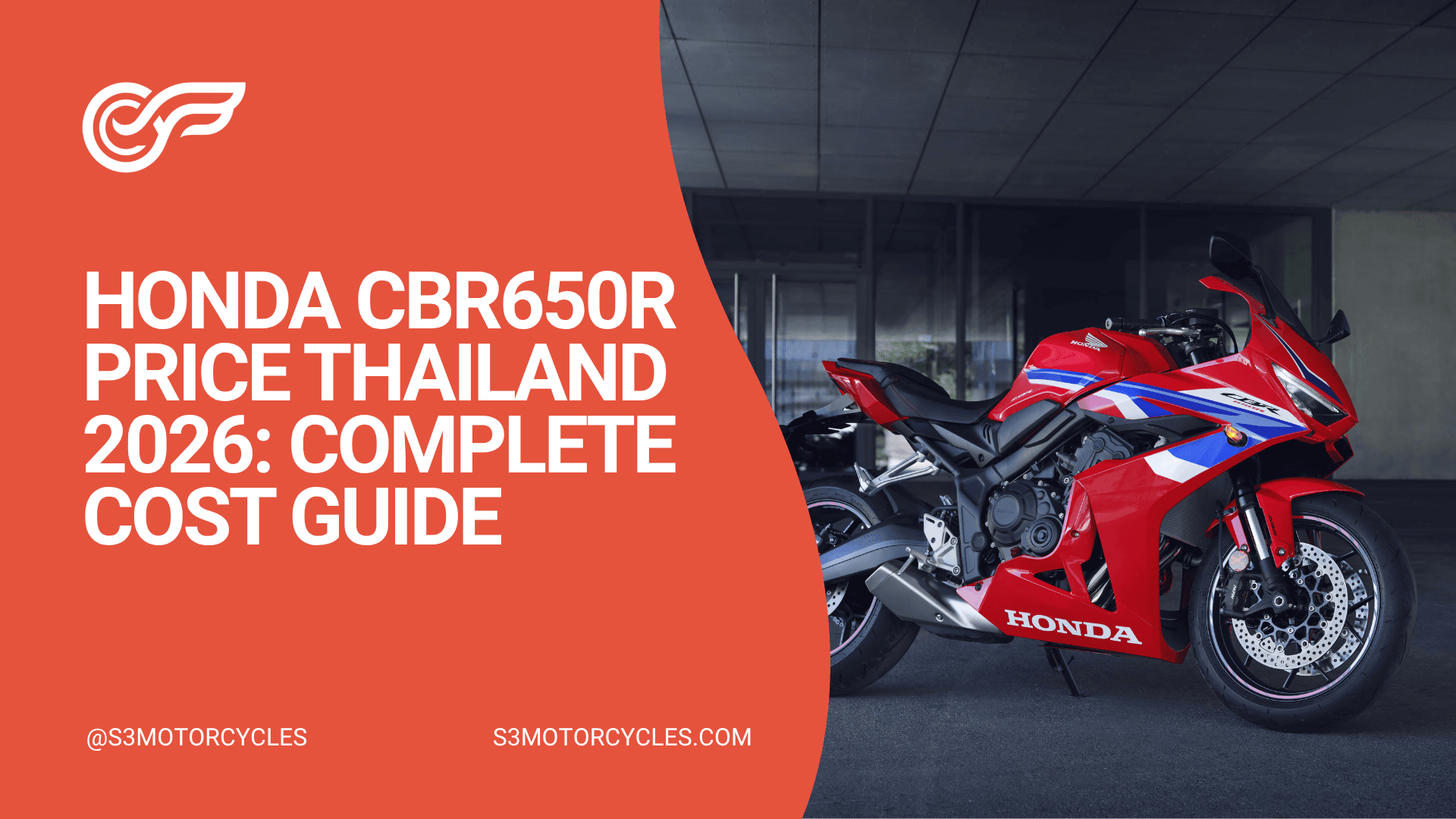 Buying Guide
Honda CBR650R Price Thailand 2026: Complete Cost Guide
Complete Honda CBR650R pricing breakdown for Thailand 2026. New vs used costs, financing options, insurance rates, and hidden ownership expenses revealed.
Apr 10, 2026
 Buying Guide
XMAX Financing Thailand: Down Payment & Monthly Plans 2025
Complete guide to XMAX financing in Thailand. Real down payment amounts, 60-month installment rates, and dealer vs bank financing options for 2025.
Apr 10, 2026